Articles
Category First Nations Show all
-
Continuing the dialogue with First Nations communities
Share Continuing the dialogue with First Nations communities on Facebook Share Continuing the dialogue with First Nations communities on X (formerly Twitter) Share Continuing the dialogue with First Nations communities on Linkedin Email Continuing the dialogue with First Nations communities linkThroughout the year, the Wasamac Mining Project team continued its engagement with several First Nations communities to provide updates on the project's progress, share information, and gather feedback from community members and representatives.
Meeting with the Cree Nation Government
On September 24, 2026, the Wasamac Mining Project team met with the Environmental Coordinator of the Cree Nation Government to present an update on the project's progress and discuss various environmental issues. Discussions focused in particular on ore transportation and water management. The meeting provided an opportunity to continue discussions and maintain an open dialogue regarding the advancement of the project.
Throughout the year, the Wasamac Mining Project team continued its engagement with several First Nations communities to provide updates on the project's progress, share information, and gather feedback from community members and representatives.
Meeting with the Cree Nation Government
On September 24, 2026, the Wasamac Mining Project team met with the Environmental Coordinator of the Cree Nation Government to present an update on the project's progress and discuss various environmental issues. Discussions focused in particular on ore transportation and water management. The meeting provided an opportunity to continue discussions and maintain an open dialogue regarding the advancement of the project.
Timiskaming First Nation Open House
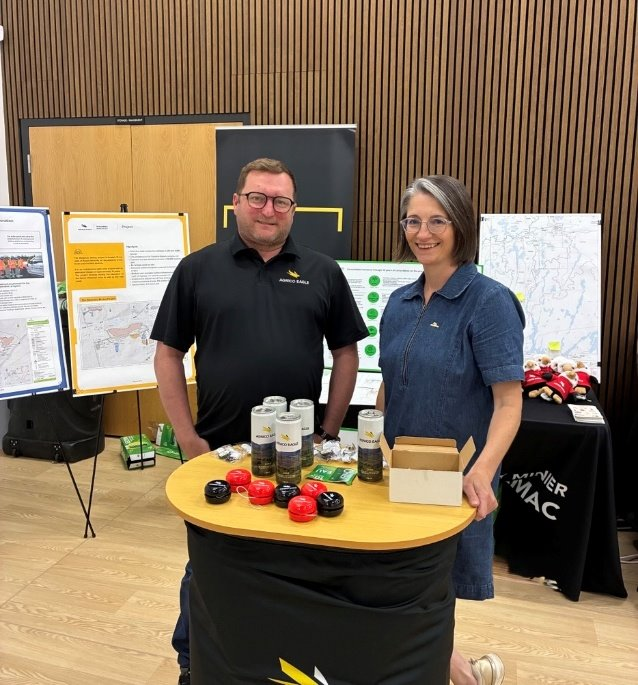
On July 8, 2026, the team participated in the open house organized by Timiskaming First Nation (TFN). The event brought together stakeholders from the mining, forestry, wind energy, and rail transportation sectors. For the occasion, members of the Wasamac team shared an information booth with the Upper Beaver Project team. Presentation materials were translated to facilitate accessible discussions with community members. Approximately 20 people visited the booth to learn more about the project. Discussions focused notably on the use of land for cultural and traditional purposes. Through a participatory mapping activity, participants were invited to identify areas they regularly use. The discussions provided valuable information regarding areas used for hunting, trapping, and gathering. Broader concerns related to environmental protection were also raised, particularly regarding water quality and the effects of deforestation on wildlife.

Continuing the Dialogue with the Abitibiwinni Community
On June 30, the Wasamac Mining Project team met with a representative of the Abitibiwinni community in Pikogan to provide an update on the project's progress and discuss the community's contribution to the Environmental and Social Impact Assessment (ESIA). During the meeting, the team presented the key features of the revised project, including the preliminary schedule, the preferred ore transportation approach, and the next steps related to bulk sampling activities. Discussions also covered the preparatory work planned over the coming years and upcoming regulatory processes. A significant portion of the meeting focused on the community's participation in the preparation of the ESIA. Discussions included updates to studies previously conducted by Abitibiwinni, revisions to sections describing the community within the impact assessment, and preferred approaches for continuing engagement. All parties reaffirmed their commitment to maintaining an open and constructive dialogue as the project continues to progress.
Project Presentation with Long Point First Nation
The Wasamac Mining Project was presented to Long Point First Nation on March 31, 2026, to provide an update on its progress and discuss future opportunities for collaboration. The presentation covered project optimizations, proposed infrastructure, water management, transportation options, advanced exploration activities, and the preliminary project schedule. Discussions also addressed the environmental assessment process, with filing anticipated in 2026, as well as opportunities for community participation. The meeting initiated discussions regarding Long Point First Nation's expectations and preferred approaches to ensuring ongoing collaboration and engagement throughout the project's development.
Project Update Meeting with Timiskaming First Nation
On March 10, 2026, the team met with representatives of Timiskaming First Nation (TFN) to discuss the project's progress and future collaboration opportunities. Discussions focused on the main modifications made to the project, including the absence of a processing plant on site, the transportation and processing of ore at the Canadian Malartic site, the reduced project footprint, and the elimination of cyanide use. Preliminary discussions were also held regarding TFN's participation in the impact assessment process. It was agreed that discussions would continue over the coming months through working sessions, information sharing, and potential site visits.
-
National Day for Truth and Reconciliation
Share National Day for Truth and Reconciliation on Facebook Share National Day for Truth and Reconciliation on X (formerly Twitter) Share National Day for Truth and Reconciliation on Linkedin Email National Day for Truth and Reconciliation link
As part of National Truth and Reconciliation Day, we take a moment to reflect, learn, and recognize the importance of building respectful and lasting relationships with Indigenous peoples.
At Agnico Eagle, we continue our commitment to reconciliation through concrete actions, awareness initiatives, and open dialogue with communities. To this end, our Reconciliation Action Plan (RAP) demonstrates our commitment to doing what is right and putting our values into action.
To view our RAP: https://s205.q4cdn.com/243646470/files/doc_downloads/1553-AE-RAP-Eng_Final-Web.pdf


On September 25, our Wasamac mining project team took part in an awareness-raising activity aimed at better understanding the realities of Indigenous peoples.
We had theContinue reading
As part of National Truth and Reconciliation Day, we take a moment to reflect, learn, and recognize the importance of building respectful and lasting relationships with Indigenous peoples.
At Agnico Eagle, we continue our commitment to reconciliation through concrete actions, awareness initiatives, and open dialogue with communities. To this end, our Reconciliation Action Plan (RAP) demonstrates our commitment to doing what is right and putting our values into action.
To view our RAP: https://s205.q4cdn.com/243646470/files/doc_downloads/1553-AE-RAP-Eng_Final-Web.pdf


On September 25, our Wasamac mining project team took part in an awareness-raising activity aimed at better understanding the realities of Indigenous peoples.
We had the privilege of being accompanied by Mr. André Mowatt, a passionate guide, during a most enlightening presentation on the history of the Abitibi8innik people through the ages. This visit also allowed us to discover the permanent exhibition located in the basement of the Pikogan church, a place steeped in memory and cultural transmission.
We warmly thank Mr. Mowatt for his generous hospitality and the wealth of information he shared with us.
Thank you also to our colleagues from La Ronde's community relations team for participating with us.
One step at a time, let's move forward together toward reconciliation.
-
2021-2022 progress report – relations with Indigenous communities and organizations as part of the impact study
Share 2021-2022 progress report – relations with Indigenous communities and organizations as part of the impact study on Facebook Share 2021-2022 progress report – relations with Indigenous communities and organizations as part of the impact study on X (formerly Twitter) Share 2021-2022 progress report – relations with Indigenous communities and organizations as part of the impact study on Linkedin Email 2021-2022 progress report – relations with Indigenous communities and organizations as part of the impact study link
Glenn Polson, Coopérative PikoganSince the launch of the impact study for the Wasamac underground mining project in March 2021, numerous communications and exchanges have taken place with the Indigenous communities and organizations interested in taking part in the assessment of the project's impacts.
Throughout the discussions, it was possible to identify various issues relating to the Wasamac project and its review, as defined and expressed by Indigenous communities and organizations. These comments, questions and suggestions contributed to the process of optimization and continuous improvement of the project, in order to prevent or limit the impacts on the environment. TheContinue reading
Glenn Polson, Coopérative PikoganSince the launch of the impact study for the Wasamac underground mining project in March 2021, numerous communications and exchanges have taken place with the Indigenous communities and organizations interested in taking part in the assessment of the project's impacts.
Throughout the discussions, it was possible to identify various issues relating to the Wasamac project and its review, as defined and expressed by Indigenous communities and organizations. These comments, questions and suggestions contributed to the process of optimization and continuous improvement of the project, in order to prevent or limit the impacts on the environment. The entire Yamana Gold team as well as the firms involved in relations with the community and the carrying out of the impact study would like to thank the teams from the Indigenous communities and organizations for their time and their contribution to improving the project and for the collaborative process.
We invite you to consult this 2021-2022 progress report to see the efforts undertaken as well as the concrete impact of the contributions received at the level of the project and its review.
-
Meetings with Indigenous communities – summer 2022
Share Meetings with Indigenous communities – summer 2022 on Facebook Share Meetings with Indigenous communities – summer 2022 on X (formerly Twitter) Share Meetings with Indigenous communities – summer 2022 on Linkedin Email Meetings with Indigenous communities – summer 2022 link
As part of the ongoing impact study, the Yamana Gold team recently had the opportunity between May and July to meet with three Indigenous communities, namely the First Nations of Abitibiwinni, Long Point and Timiskaming. The objective of these meetings was to discuss with them and some of their members on the evolution of the project and the environmental impact study to which several communities are contributing, to hear their concerns and suggestions for improvement on the project and to take stock of the various collaboration and business opportunities available to them in the months and years to come. MembersContinue reading
As part of the ongoing impact study, the Yamana Gold team recently had the opportunity between May and July to meet with three Indigenous communities, namely the First Nations of Abitibiwinni, Long Point and Timiskaming. The objective of these meetings was to discuss with them and some of their members on the evolution of the project and the environmental impact study to which several communities are contributing, to hear their concerns and suggestions for improvement on the project and to take stock of the various collaboration and business opportunities available to them in the months and years to come. Members of the Yamana team were warmly welcomed to the 3 communities and would like to thank them for their respective contribution to the ongoing dialogue as the project evolves.
It should be noted that operational agreements are in place with certain communities to confirm their involvement, in particular in the conduct of inventories, the revision of studies on various components of the project and sometimes even the production of studies led by themselves.
A series of thematic meetings with the communities concerned is planned for September with the aim of continuing to solicit their ideas, advice, and concerns in order to build a project that respects their interests, values and ancestral presence in the territory.